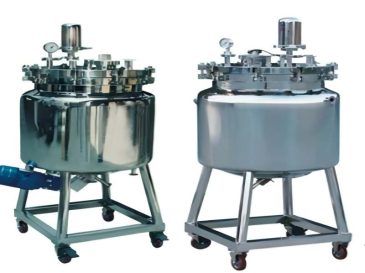
1. Product Overview & Core Purpose
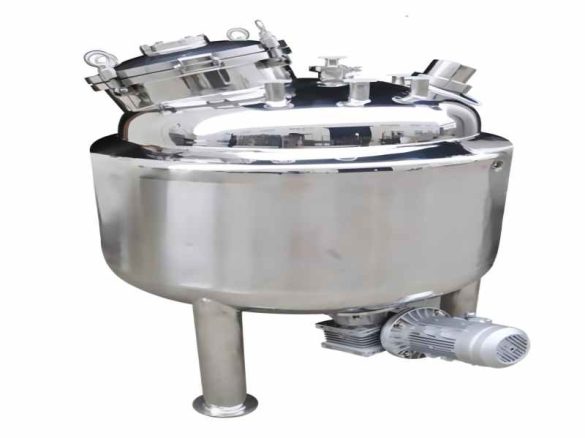
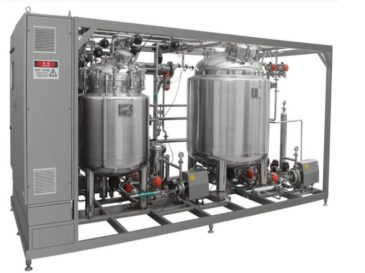
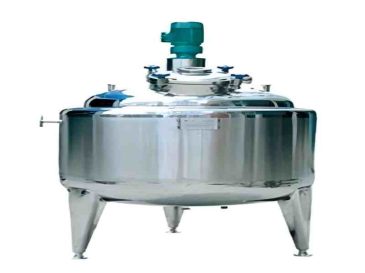
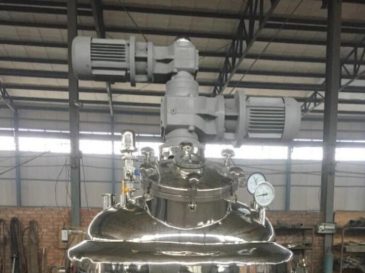
We design a Pharmaceutical Liquid Mixing Tank (also called a blending tank or stirring tank) primarily as a vertical mixing vessel. It achieves process production requirements by agitating materials through the tank’s stirring operation. This equipment acts as a necessary device for intermediate buffering, liquid storage, stirring, blending, and reaction in pharmaceutical, bioengineering, and food production industries.
2. Main Structural Components
A pharmaceutical liquid mixing tank (or vacuum blending tank) typically consists of several key parts:
- Tank body: The main cylinder structure
- Tank cover: Also known as the head
- Heating/cooling system: Jacket or coil for heating/cooling circulation
- Agitation system: Upper mechanical agitator (available in anchor type, paddle type, turbine type, etc.)
- Transmission device: Motor-reducer combination
- Shaft seal device: Mechanical seal for leak prevention
- Supports: Platforms and legs for stability
- Thermal insulation media: For temperature maintenance
The system configuration of the tank mainly includes transmission devices, mechanical seal devices, temperature control devices, cooling devices, as well as weighing and metering devices, and liquid level metering devices.
3. Core Functions & Customizable Design Options
3.1 Standard Functions
A pharmaceutical liquid mixing tank integrates essential functions such as heating, cooling, thermal insulation, stirring, and metering.
3.2 Customizable Systems
According to production and process requirements, we can design it with:
- Heating/cooling systems
- Low/high-speed stirring systems
- Sealed pressure-bearing systems
- Vacuum systems
- Metering systems
3.3 Agitator Configuration
For different stirred materials and required stirring effects, we can adjust the agitator structure, including:
- Turbine type
- Paddle type
- Anchor type
- Frame type
- Ribbon type
- Magnetic agitator
3.4 Metering Selection
Depending on the material ratio and state, we can select:
- Weighing batching
- Flow metering
- Liquid level metering
4. Process Nozzles & Connection Specifications
4.1 Standard Nozzle Configuration
We equip the tank body with various process nozzles:
- Manhole (which can also serve as a solid feeding port)
- Feeding port
- Discharging port
- Sight glass
- Lighting lamp
- Breathing port
- CIP port (equipped with a sanitary universal cleaning ball)
- SIP port
- Sterile sampling port
- Thermometer
- Temperature sensor
- Inlet/outlet for hot and cold media
- Sampling port
4.2 Customization & Connection Types
We can design and manufacture nozzles according to process requirements. The connection forms include:
- Quick-install clamp type
- Flange type
- Threaded type
5. Classification by Heating & Jacket Methods
5.1 Heating Methods
We classify pharmaceutical liquid mixing tanks by heating methods into:
- Electric heating type
- Oil heating type
- Steam heating type
- Water heating (or cooling) type
5.2 Jacket Configurations
Jacket configurations include:
- Jacketed type
- External half-pipe type
Note that oil-heated jackets all feature flow guiding devices.
6. Agitation & Transmission Systems
6.1 Agitation Types
Agitation types generally include:
- Paddle agitators
- Anchor agitators
- Frame agitators
- Ribbon agitators
- Wall-scraping agitators
High-speed types are also available for selection based on processes:
- Dispersion impeller
- Turbine type
- High-shear type
- Propeller type
6.2 Transmission & Speed Control
Transmission types include:
- Ordinary motors
- Explosion-proof motors
- Electromagnetic speed-regulating motors
- Frequency converters
Speed reducers include:
- Cycloidal-pinwheel type
- Worm gear type
- Planetary stepless speed-varying type
6.3 Shaft Seals & Discharge Forms
Shaft seals combine:
- PTFE packing seals
- Mechanical seals
Discharge forms include:
- Ball valves
- Tank bottom valves
7. GMP Compliance & Quality Standards
All process openings for inlet/outlet nozzles and their welding points with the inner tank body adopt flanged arc transition technology. This design ensures:
- Smooth surfaces for easy cleaning
- No dead corners
- Aesthetic appearance
Most importantly, this design fully complies with pharmaceutical GMP standards.