1. Industry Challenges & Innovation Background
In the chemical industry’s organic solvent waste liquid recovery, mixed solvent separation remains a key research focus.
Domestic and foreign studies show that experts struggle to fully separate mixed solvents. Additionally, current Chinese distillation technologies have significant limitations; most can only separate a few selective solvents, thus failing to meet ideal separation goals.
Traditional solvent recovery equipment features tall, heavy towers that occupy large space, require high initial costs, and demand extensive manual labor. Furthermore, its separation effect is also unsatisfactory.
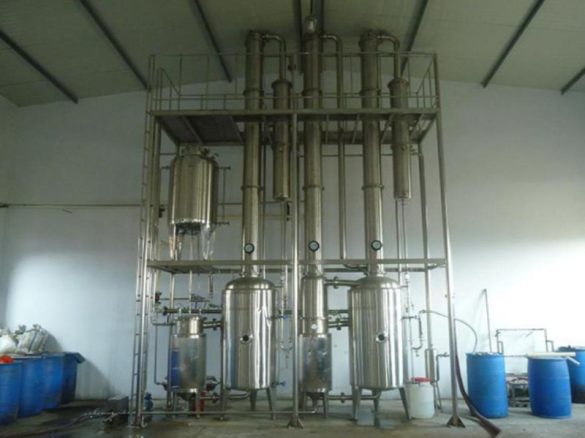
To address these pressing issues, we combined years of design experience with customer needs and developed a new series-connected multi-stage distillation solvent recoverer based on multi-stage distillation principles. This equipment largely solves the existing limitations in solvent recovery.
2. Core Advantages & Performance
2.1 Structural & Operational Benefits
The series-connected multi-stage distillation solvent recoverer features a compact structure, low initial costs, a small footprint, and minimal space occupation. Its manual operation range is narrow, making operation simple and efficient.
Its biggest advantage lies in eliminating the need for tall distillation towers. Moreover, it achieves higher solvent purity than traditional equipment, making it ideal for recovering widely used methanol and ethanol.
Instead of forced or liquid level difference reflux, the equipment uses internal reflux. This design delivers an obvious reflux effect, with alcohol content typically exceeding 95%.
2.2 Advanced Process Design
While the equipment relies on distillation technology, it abandons single-tower distillation and instead adopts two-stage heating and three-stage distillation for better separation results.
Calculations show that the first tower’s packing theoretical plates are 1.5 times those of the traditional tower’s rough distillation section and also 1.5 times the theoretical plates of the latter two-stage distillation towers.
Based on years of industry experience, we designed a patented device in the separation chamber, whose performance far exceeds that of traditional alcohol recovery towers.
3. Model Varieties & Applications
3.1 External-Circulation Multi-Tower Distillation Recoverer
This model integrates multiple towers and multiple effects, enabling it to concentrate materials under vacuum conditions.
Additionally, it recovers single or multiple solvent media with different boiling points and densities during the concentration process. It offers high efficiency, wide applications, and relatively high recovery purity.
3.2 Internal-Circulation Solvent Recoverer
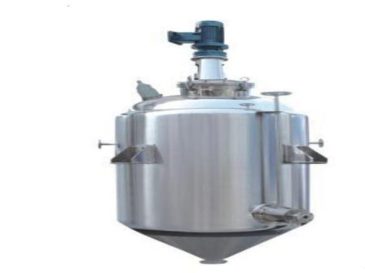
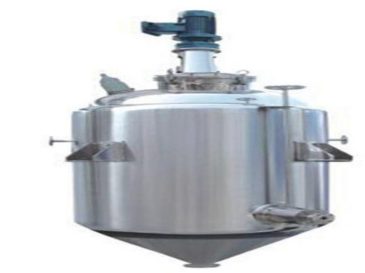
This model specializes in separating and recovering both high and low concentration inorganic and organic solvents.
Specifically, it can handle water mixtures, ethanol, methanol, ethers, ethyl acetate, n-butanol, butyl acetate, butanone, acetone, and many other organic solvents.
4. Space & Operational Efficiency
4.1 Significant Space Reduction
By using precision packing and multi-stage distillation, the equipment’s height is reduced by over 60% compared to traditional models.
Traditional equipment requires tower heights above 12 meters to reach approximately 95% ethanol concentration, whereas the new device achieves over 95% ethanol recovery with a tower height below 3 meters.
This design not only saves nearly 60% of space but also reduces labor intensity for operators.
4.2 Easy Operation & Maintenance
For fully automatic models, operators can monitor the entire process via computers. There is no need to climb high, as ground operation is convenient and time-saving.
The unique design also saves approximately 20% of manufacturing raw materials, making the equipment lightweight, attractive, easy to install, flexible, and convenient to transport.
Compared to traditional equipment of the same specification, it saves around 60% of space and reduces the floor area by over 30%, making it ideal for small-space workshops.
Traditional equipment is tall, heavy, material-intensive, and energy-consuming, with low recovery rates and poor purity. Therefore, the new recoverer is a better choice for replacing traditional distillation equipment.
5. Competitive Advantages
Compared to new permeable filtration membranes, the recoverer has seven distinct advantages: low cost, long service life, no easily damaged parts, wide application, easy cleaning, no blockage, and easy maintenance.
In contrast, new permeable filtration membranes only perform selective single dehydration and cannot separate multiple organic solvents. They are also hard to clean, expensive, easily damaged, and require frequent replacement.
As a new-generation distillation recovery equipment, the series-connected multi-stage distillation solvent recoverer surpasses both traditional distillation equipment and new permeable filtration membranes.
6. Energy-Saving Technologies
The equipment adopts two energy-saving steam heating methods to reduce energy consumption effectively.
6.1 Series Waste Heat Utilization
Instead of directly discharging heating condensate, we introduce it into the second reboiler for waste heat reuse via the step-type temperature difference principle.
6.2 Thermal Coupling Heating
Combining thermal coupling and step-type temperature difference principles, the equipment uses high-pressure tower steam to heat low-pressure tower solvents.
These two methods save both steam and circulating cooling water. Actual tests show that the first method saves approximately 20% steam, while the second saves around 30% steam (depending on specific processes)—savings that traditional distillation equipment cannot achieve.