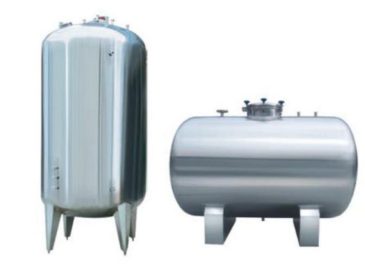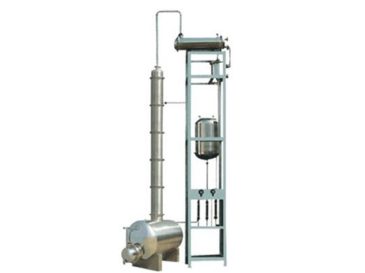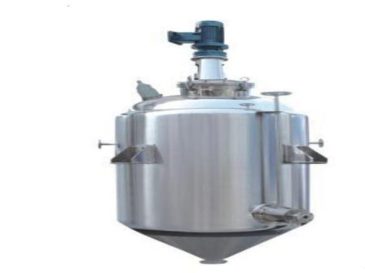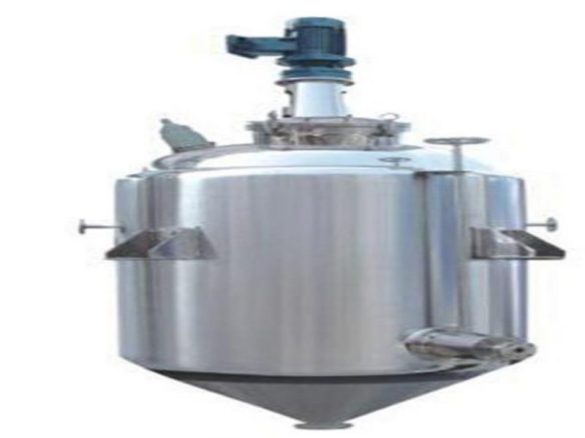
We use a precipitation tank to separate insoluble substances from soluble ones in a solution.
For example, we add ethanol to water-extracted solutions to precipitate alcohol-insoluble materials like starch, gum, protein, pectin, and mucilage pigments.
The ethanol supernatant then contains valuable soluble compounds such as tannins, alkaloids, alcohol-soluble amino acids, and glycosides.
This method effectively removes impurities and extracts medicinal active ingredients.
We widely apply precipitation tanks in traditional Chinese medicine, condiments, sugar making, and pesticide industries.
It excels at separating precipitation solutions in both the food and traditional Chinese medicine industries.
A precipitate tank mainly comprises a tank body, a head, a mechanical stirring transmission device, a jacket, a heat exchange system (including heat exchange tubes), an adjustable supernatant outlet, and a lower slag discharge port.
To facilitate precipitate separation, the cylindrical upper section typically uses an elliptical head, while the lower section adopts a conical head with a cone angle of 60°–120°.
After precipitation, impurities settle at the cone bottom. We then discharge the clear liquid from the upper part via the supernatant outlet.
The transmission system of a precipitate tank generally includes a motor, a reducer, a seal, a frame, and a stirring device.
For larger container loads, we select low-speed stirring; for smaller loads, we choose higher speeds.
This system ensures uniform solvent mixing within materials.
In turn, uniform mixing promotes optimal selective separation between solvents and solutes.
We customize stirring devices based on tank size and the composition of traditional Chinese medicine water extraction solutions.
We design and manufacture stirring support specifications according to actual operational needs.
We craft the inner tank from high-quality SUS316L/304 stainless steel and polish its surface to meet food and pharmaceutical hygiene standards.
The interlayer uses SUS304 stainless steel, and we install a stainless steel deflector inside to guide cooling water effectively.
We weld a stainless steel outer casing and apply polyurethane insulation to retain heat, prevent rapid heat loss, and ensure energy efficiency.
The precipitate tank integrates heating/cooling, heat preservation, and stirring functions.
We design process nozzles for material inlet, pure water port, discharge port, sampling port, and heat exchange inlets/outlets on the tank body.
We also equip it with an automatic control system for feeding, discharging, temperature control, and stirring.
This system reduces labor intensity and enables fully automated control of the entire precipitation process.
| Item | Unit | 300L | 500L | 1000L | 1500L | 2000L | 3000L | 6000L |
|---|---|---|---|---|---|---|---|---|
| Nominal Volume | – | 300L | 500L | 1000L | 1500L | 2000L | 3000L | 6000L |
| Effective Volume | m³ | 0.3 | 0.5 | 1.0 | 1.1 | 2.0 | 3.0 | 6.0 |
| Heat Exchange Area | m² | 1.9 | 3.2 | 4.3 | 5.0 | 6.3 | 8.5 | 12.1 |
| Agitation Power | KW | 0.55 | 0.75 | 1.5 | 3.0 | 4.0 | 5.5 | 7.5 |
| Cooling Water Consumption | Kg/h | 1320 | 2225 | 3312 | 4600 | 5670 | 6430 | 9580 |
| Equipment Weight | Kg | 512 | 1250 | 1480 | 1750 | 1880 | 2200 | 4000 |
| Rotating Speed | r/m | Constant speed or variable frequency speed regulation | – | – | – | – | – | – |
| Stirring Form | – | Designed and manufactured according to material properties | – | – | – | – | – | – |
| Working Pressure | Mpa | Designed and manufactured according to process conditions | – | – | – | – | – | – |
| Working Temperature | °C | – 15 ~ Normal temperature or high temperature | – | – | – | – | – | – |
| Jacket Heating/Cooling Medium | – | Cooling water/heating medium | – | – | – | – | – | – |
| Thermal Insulation Material | – | Polyurethane | – | – | – | – | – | – |
| Pipe Port Configuration | – | Can be designed as needed under meeting conditions | – | – | – | – | – | – |
| Tank Material | – | SUS304/316L or other inner – lined anti – corrosion stainless steel materials | – | – | – | – | – | – |
| Container Category | – | Atmospheric pressure container | – | – | – | – | – | – |