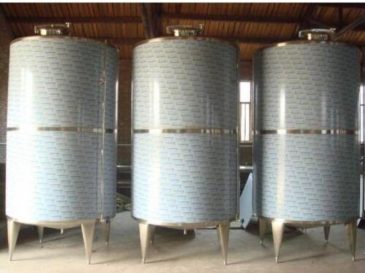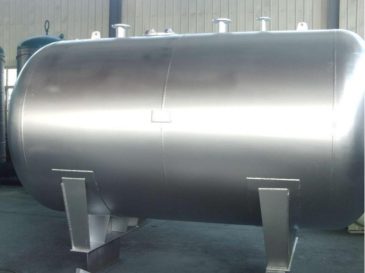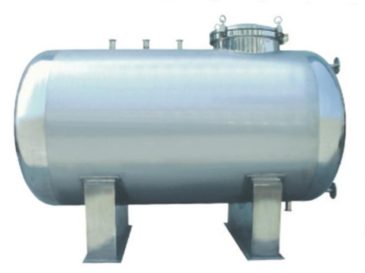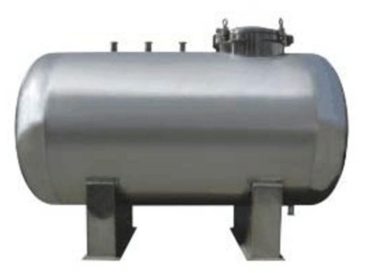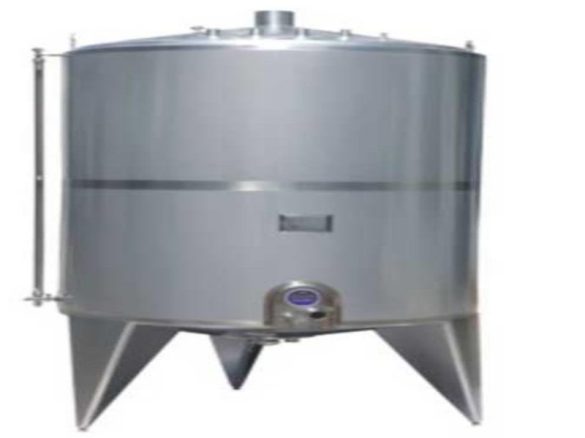
We define the double-layer insulation storage tank against single-layer tanks and three-layer heating tanks.
It is a storage tank with insulation medium and layer, so it keeps materials warm or cold for a period of time.
Its main role is to prevent quick temperature drops and reduce heat loss.
Notably, it maintains stable temperature for short periods, not permanent constant control.
In production lines, you can use it between work shifts to store hot materials from heating tanks.
This arrangement effectively improves overall production efficiency.
Common examples include hot water tanks, cold water tanks, and insulated medicinal liquid tanks.
If you need extra functions, you can also add an electric heating device to the tank.
This upgrade gives it both heating and long-term constant temperature functions.
Vertical and horizontal are the two common structural forms.
Besides shape, tanks can use full insulation or partial insulation.
Compared with single-layer tanks, their structure is slightly more complex.
Thanks to the insulation layer, they save energy by reducing heat exchange with the outside.
This tank has a low overall cost.
It discharges from the side bottom at the lowest point.
Because of its design, the equipment height is relatively low.
Therefore, it suits low-viscosity and low-concentration materials.
For the top cover, you can choose a side-opening cover or a sealed manhole.
This model also costs relatively little.
What’s more, it discharges cleanly with little material residue.
It is ideal for medium-viscosity and medium-density materials.
Like Type 1, the top design offers the same flexible options.
This structure includes a manhole on top.
It discharges from the cone bottom center.
Additionally, it seals well and uses a fully enclosed design.
As a result, it suits normal-pressure insulated material storage.
This style also has a manhole and bottom-center discharge.
It features a fully enclosed structure and clean discharge.
Due to strong pressure-bearing performance, it fits pressurized processes.
Among all types, it has the highest cost.
For projects with high-sanitation and high-sealing demands, processes usually choose Type 4.
This type supports online CIP cleaning and stable heat preservation.
We mirror-polish the inner tank surface to Ra ≤ 0.6μm.
For all connections, we stretch and flange nozzle, sight glass, and manhole joints.
These joints use arc transitions for smooth, dead-corner-free surfaces.
This detail makes cleaning easy and reliable.
Most importantly, it fully meets cGMP and other strict industry specifications.
| Liquid Level Gauge Type | Glass tube liquid level gauge, hydrostatic transmission – type liquid level gauge, ultrasonic liquid level gauge, etc. (optional) |
|---|---|
| The form of supporting legs | Adjustable triangular pyramid type or round tube type |
| Accessory Configuration | Quick – opening sanitary manhole, peephole light mirror, breather, CIP cleaner, material liquid inlet and outlet (supernatant liquid outlet), and other interfaces |