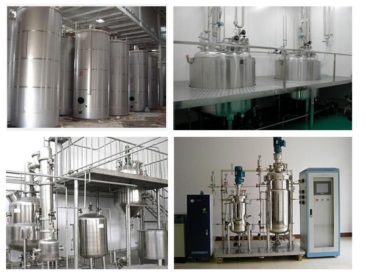
Overview & Basic Definition
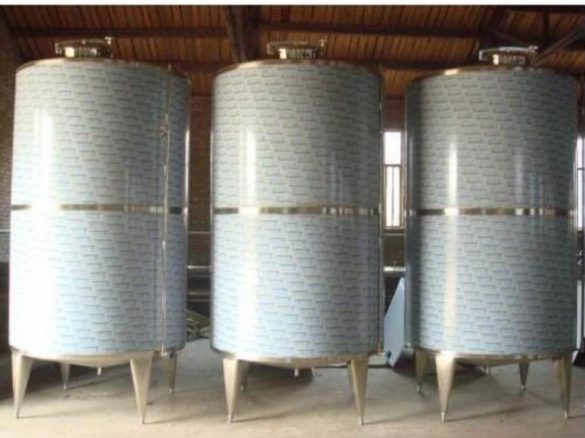
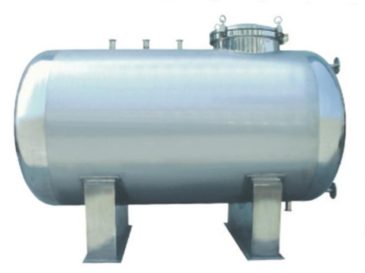
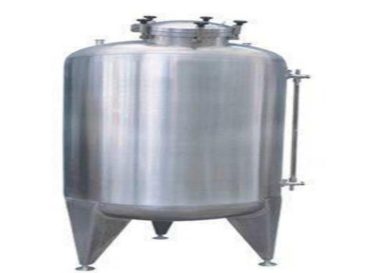
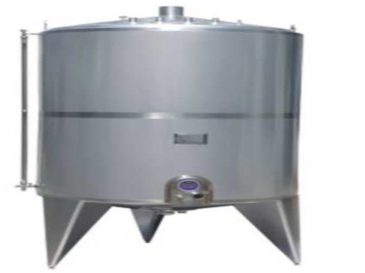
A temporary storage tank is a stainless steel tank for temporary storage, buffering, or material feeding. Additionally, it is a commonly used type of stainless steel tank. It mainly has three types: fixed (ground-mounted with legs), mobile stainless steel, or mobile material bucket. Moreover, its typical process applications include temporary storage, heating, and heat preservation.
Alternative Names & Application Industries
Besides its official name, it also goes by other names: stainless steel temporary storage tank, buffer tank, or surge tank. It serves as a common intermediate equipment in many industries; specifically, these industries include pharmaceuticals, biology, food, fine chemicals, and fermentation.
Material & Surface Treatment
Manufacturers use SUS316L or SUS304 stainless steel for the entire tank body. Meanwhile, the inner surface undergoes mirror polishing, and as a result, its roughness reaches Ra ≤ 0.4 μm.
Classification
By form: It has two types—vertical and horizontal tanks. By pressure requirement: In contrast, we categorize it into stainless steel pressure and non-pressure vessels. By structure: Furthermore, our classification includes three types—single-layer, double-layer (with insulation), and three-layer (with insulation and jacket).
Main Structure
A temporary storage tank mainly consists of a tank body and accessories. Specifically, the tank body includes a cylinder, supporting legs (or brake-equipped casters), heads, jacket, and insulation. The cylinder is cylindrical, with standard elliptical or dished upper and lower heads, and it uses 304 or 316L stainless steel as the main material. For insulation, materials are mostly polyurethane or rock wool, with a thickness of 50-100 mm.
Accessories
Main accessories include sanitary manholes, sight glass lamps, and material inlets/outlets, as well as process nozzles and CIP cleaning ports. On the other hand, optional accessories include level gauges, thermometers, and cleaning balls; besides these, other options are breathers, weighing modules, pressure gauges, and safety valves.
Material Advantages
All liquid-contacting parts use 304 or 316L stainless steel, a material that is non-toxic, non-shedding, and corrosion-resistant. First, this material ensures medicine and food quality; second, it also extends the equipment’s service life.
Operational Performance
Tank accessories are reasonably distributed, including manholes, inlets/outlets, level gauges, and breathing valves. Because of this rational layout, observation and operation become simple and efficient.
Sanitary Performance
Heads are standard elliptical or dished. To ensure smoothness, workers form rounded corners via Japanese-style flat-plate hydraulic pressing. Additionally, all nozzle joints undergo drawing treatment for smooth arc transitions, with the arc radius no less than 10 mm. For the tank welds, workers use automatic or manual argon arc welding and also perform stress relief treatment on the welds to enhance stability.
Furthermore, equipment surfaces (inner and outer) undergo mechanical precision polishing, which ensures inner surface roughness Ra ≤ 0.6 μm. As a result, it avoids product residue and reduces cleaning difficulty, while also meeting hygienic-grade tank requirements. Finally, workers pickle and passivate the inner surface, which further enhances corrosion resistance and service life.