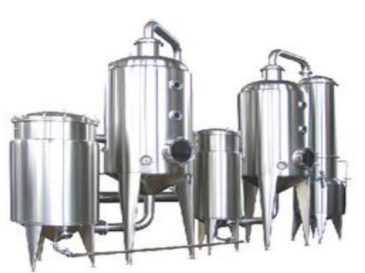
Product Overview and Application Scope
The single-effect concentrator has characteristics that suit industrial alcohol recovery. It is widely used in industries such as traditional Chinese medicine, western medicine, glucose, brewing, starch, oral liquids, chemicals, food, natural flavorings, and food additives.
Additionally, it applies to monosodium glutamate and dairy product industries. Moreover, it is ideal for vacuum concentration of small batches, multiple varieties, and low thermal sensitivity materials. Besides, its adaptability makes it a practical choice for many enterprises.
Core Functions and Advantages
1. Alcohol Recovery
It has a large recovery capacity and adopts a vacuum concentration process. Compared with old-type single-effect concentrators of the same kind, it increases productivity by 5-10 times. In particular, this productivity boost helps enterprises improve production efficiency significantly.
At the same time, it reduces energy consumption by 30%. It also features small investment and high recovery efficiency, making it cost-effective for enterprises. Furthermore, its low investment threshold makes it accessible to small and medium-sized enterprises.
2. Concentration of Liquid Materials
The single-effect concentrator combines external heating natural circulation with vacuum negative pressure evaporation. This design ensures fast evaporation speed and a concentration ratio of up to 1.3. Specifically, the dual design enhances its overall performance and stability.
It concentrates liquid materials in a fully sealed state without foam. The medicinal liquid it concentrates is pollution-free and rich in medicinal flavor. Unlike traditional equipment, it avoids contamination during the concentration process.
Furthermore, it is easy to clean—operators only need to open the upper and lower covers of the heater for cleaning. It is also simple to operate and occupies a small floor area. In addition, its simple operation reduces the need for professional training for operators.
Both the heater and evaporator adopt stainless steel thermal insulation structures. Workers enclose the insulation layer with a stainless steel thin plate shell, and they perform mirror-finished or matt treatment on the surface. This treatment not only enhances aesthetics but also improves corrosion resistance.
Equipment Composition and Material
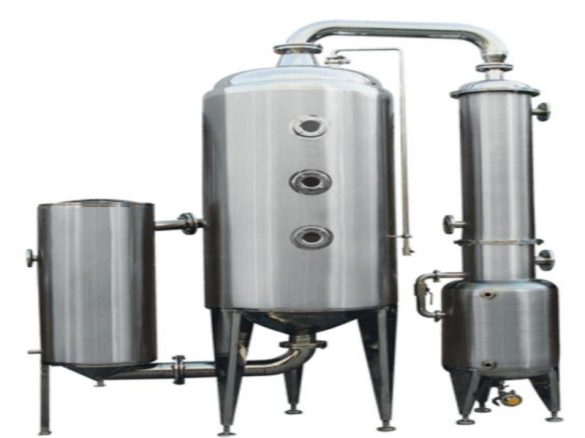
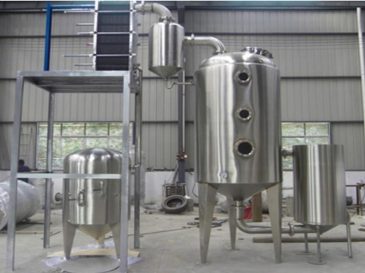
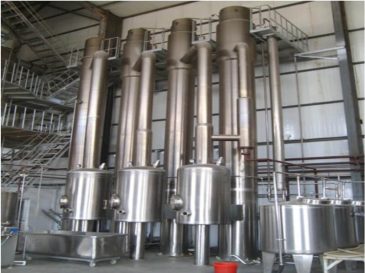
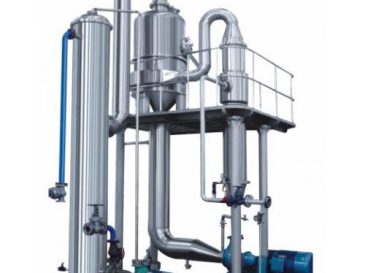
The single-effect concentrator consists of multiple components. These include a heating chamber, separator, defoamer, vapor-liquid separator, condenser, cooler, liquid storage tank, and circulation pipe. All these components work together to ensure stable operation.
Importantly, we make the entire set of equipment from high-quality stainless steel materials. This material ensures durability, corrosion resistance, and compliance with hygiene standards. Besides, stainless steel also makes the equipment easy to clean and maintain.
Key Component Details
1. Heating Chamber
The heating chamber has a tubular structure inside. The shell side connects to raw steam, which heats the liquid inside the heating tubes. As a result, the liquid can reach the required temperature quickly for subsequent processes.
We equip the liquid addition chamber with a pressure gauge and safety valve. These components ensure the safety of production operations. In case of abnormal pressure, the safety valve will automatically release pressure to avoid risks.
2. Separation Chamber
We equip the front of the separation chamber with a sight glass. This allows operators to observe the evaporation status of the material liquid clearly. Consequently, operators can adjust the process in a timely manner based on the observed status.
The rear manhole facilitates internal cleaning of the chamber when changing varieties. We also equip it with a thermometer and vacuum gauge. These instruments are essential for real-time monitoring during operation.
These instruments let operators observe and monitor the temperature of the material liquid in the evaporation chamber and the vacuum degree during negative pressure evaporation. Thus, operators can ensure the process meets the required standards at all times.
Working Principle
Raw steam enters the outer side of the tubular bundle in the heating chamber. It then heats the material liquid, causing it to rise. Next, the heated liquid moves to the next stage of the process.
The liquid is sprayed into the evaporation chamber through a nozzle for vapor-liquid separation. After separation, the material liquid returns to the lower part of the heating chamber via the circulation pipe for reheating. This cyclic process ensures full concentration of the material liquid.
The heated liquid is sprayed again into the evaporation chamber, forming a continuous circulation. When the material liquid is concentrated to a certain degree, operators sample it to confirm compliance before discharging it from the outlet. This sampling step ensures the final product meets quality requirements.
Vapor Treatment Process
The vapor evaporated in the evaporation chamber first passes through a defoamer to eliminate foam. It then goes through a vapor-liquid separator for further separation. This two-step treatment ensures the purity of the vapor and liquid.
Part of the material liquid is returned to the evaporation chamber for reuse. The remaining secondary steam is cooled into liquid by a condenser and cooler, then enters the liquid storage tank. This reuse design further improves energy efficiency.
Finally, non-condensable gases are discharged into the atmosphere or carried away by a vacuum pump. This ensures the internal pressure of the equipment remains stable and avoids potential safety hazards.
Compliant Standards
The single-effect concentrator complies with multiple national and international standards. These standards ensure its quality, safety, and compliance with industry requirements. For instance, it meets the strict requirements of pharmaceutical and food industries.
-
SFDA Good Manufacturing Practice for Drugs (2010 Edition)
-
Code for Design of Clean Rooms in Pharmaceutical Industry (GB50457-2008)
-
GAMP (Good Automated Manufacturing Practice) for Pharmaceutical Production
-
GB150.1~150.4-2011 Steel Pressure Vessels
-
NB/T47003.1-2009 Steel Welded Atmospheric Pressure Vessels