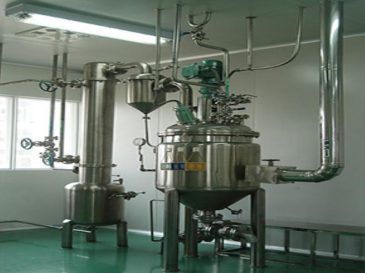
Basic Definition and Application Scope
MVR stands for “Mechanical Vapor Recompression”. We also call it an MVR mechanical compression evaporator, fully named Mechanical Vapor Recompression Evaporator. Its basic principle is to recover and mechanically recompress waste heat steam from evaporation. This improves the steam’s cleanliness and enthalpy for reuse, achieving energy conservation and environmental protection.
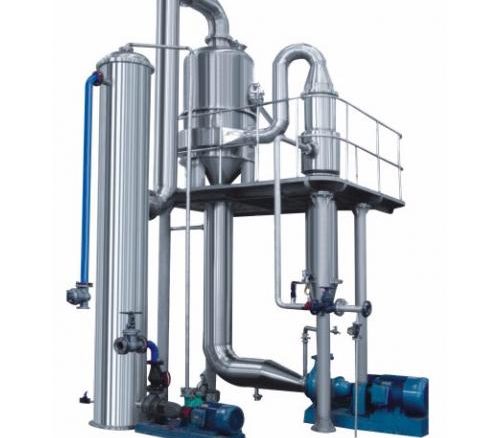
The forced circulation evaporator, also known as the multi-effect forced circulation evaporator, is a high-efficiency energy-saving concentration equipment. It operates under vacuum and low-temperature conditions. It has fast liquid flow, rapid evaporation, and anti-scaling properties. This makes it suitable for concentrating materials with high viscosity, high concentration, and scaling tendency. It is widely used in the food and chemical industries for concentration and crystallization. It also processes and concentrates fruit juices and high-concentration ethyl sugar.
Core Working Principle and Classification
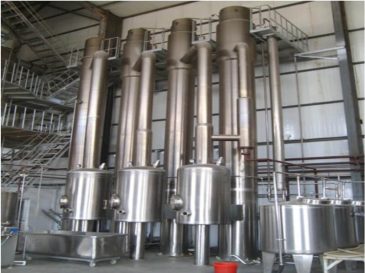
The forced circulation evaporator relies on an external circulation pump to drive liquid circulation. Its heating chamber has two structures: horizontal and vertical. A pump regulates the liquid circulation speed. This evaporator suits solutions prone to crystallization or scaling. Its main drawback is higher energy consumption. We classify forced circulation evaporators into single-effect, double-effect, triple-effect, quadruple-effect, and multi-effect types.
System Composition
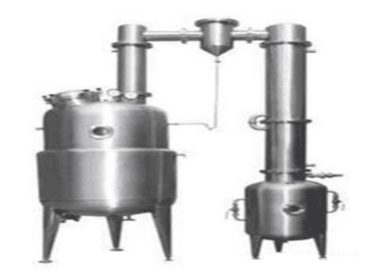
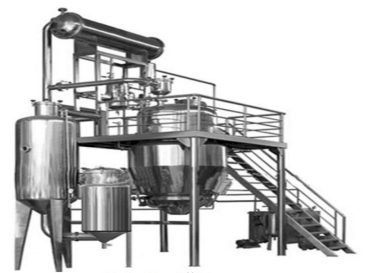
The system consists of core components and supporting systems. Specifically, it includes: evaporators for each effect, separators for each effect, condenser, circulation pump, inter-effect pump, vacuum and drainage system, steam header (steam manifold), operation platform, electrical instrument control cabinet, and auxiliary systems like valves and pipelines.
In detail, the equipment is composed of: single/double/triple/multi-effect heaters, single/double/triple/multi-effect evaporation-separation-crystallization chambers, circulation pipes, steam-liquid separators, mixed condensers, vacuum pumps, thick slurry discharge pumps, single/double/triple/multi-effect forced circulation pumps, condensate pumps, electrical control boxes, workbenches, and all pipelines, valves, and instruments.
Key Component Details
Heater: Heating tubes are made of stainless steel. The first-effect heater uses live steam. Subsequent effects use secondary steam from the previous effect’s crystallization chamber as the heat source. The liquid enters the second-effect heater from the bottom via a forced circulation pump. It exits from the top and enters the second-effect evaporation-separation chamber tangentially for circulation. During concentration, part of the material flows back to the first-effect feed pipe. The first-effect pump drives the material through heaters and into the evaporation-separation chamber tangentially for better steam-liquid separation. After normal operation, feed rate equals the sum of evaporation rates and discharge rate.
Evaporation-separation-crystallization chamber: It is a vertical cylinder with a conical bottom for easy crystal slurry discharge. Secondary steam exits from the top, passes through a steam-liquid separator, and enters the condenser. The conical bottom connects to the circulation pump.
Steam-liquid separator: It prevents fine liquid droplets from escaping with secondary steam. This reduces material loss and avoids pipeline/cooling water contamination. Baffles are set in the steam channel. Steam with droplets changes direction repeatedly and collides with baffles; droplets separate due to greater inertia.
Condenser: It condenses secondary steam into liquid using cooling water. It also separates non-condensable gases for extraction by the vacuum system. This reduces the vacuum system’s load and ensures the required vacuum degree. It consists of a mixing chamber, gas-liquid separator, and barometric leg.
Core Advantages and Operational Features
The entire system has a rational, aesthetic design, stable operation, high energy efficiency, and low steam consumption. It has a large concentration ratio. The forced circulation mechanism evaporates high-viscosity materials easily and shortens concentration time.
A special design allows easy effect switching for different product production. Low evaporation temperature ensures heat utilization and preserves product quality, suiting heat-sensitive materials. Forced circulation ensures uniform tube heating, high heat transfer coefficient, and prevents “dry wall”.
The material undergoes re-separation in the separator, enhancing efficiency and operational flexibility. The equipment is compact, occupies little space, and has a smooth layout. It supports continuous feeding and discharging, with automatic control of liquid level and concentration.