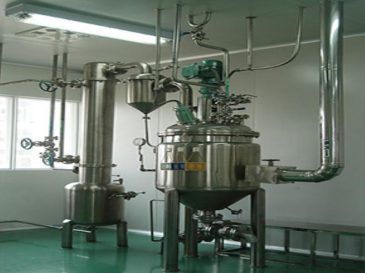
1. Overview of Evaporation and Evaporators
1.1 Definition of Evaporation
Evaporation is an operation where we heat the solution in a concentrator to its boiling point, vaporize and remove part of the solvent, and thereby increase the solution concentration. It is also a separation process that separates the volatile solvent from the non-volatile solute in the solution.
1.2 Definition of Evaporators and Falling Film Evaporators
We call the equipment used to achieve evaporation an evaporator, which is also known as a concentrator. Therefore, we also refer to a falling film evaporator as a falling film concentrator.
2. Working Principle of Falling Film Evaporators
2.1 Basic Type and Feed Liquid Process
The falling film evaporator is a type of evaporator that adopts single-effect falling film evaporation. We add the feed liquid from the upper header of the heating chamber of the falling film evaporator. A liquid distribution and film-forming device then distributes it evenly into each heat exchange tube, and the feed liquid flows downward in a uniform film shape under the action of gravity, vacuum induction, and air flow.
2.2 Heating, Vaporization and Separation
During the flow process, the heating medium in the shell side heats and vaporizes the feed liquid. The generated vapor and liquid phase jointly enter the separation chamber of the evaporator. After we achieve sufficient vapor-liquid separation, the vapor enters the condenser for condensation (for single-effect operation) or enters the next-effect evaporator as a heating medium to achieve multi-effect operation, while we discharge the liquid phase from the separation chamber.
3. Equipment Composition and Application Scope
3.1 Main Body Composition
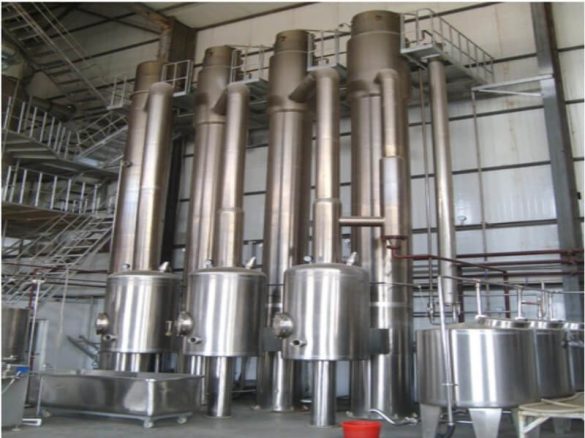
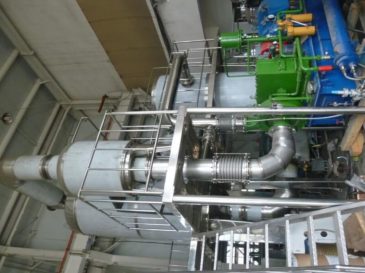
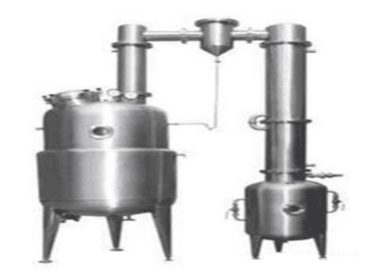
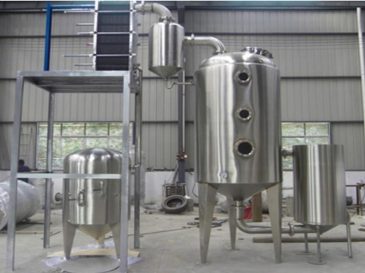
The main body of the equipment consists of a single-effect heater, single-effect separator, thermocompressor, condenser, sterilizer, heat preservation pipe, material pump, water pump, drainage system, steam header, operation table, electrical instrument control cabinet, valves, and pipelines. All these components work together to ensure the stable operation of the evaporator.
3.2 Application Industries and Materials
Falling film evaporators are suitable for low-temperature concentration in food, chemical, and environmental protection industries. For example, they can process materials such as milk, glucose, starch, and xylose, meeting the concentration needs of various heat-sensitive and common materials.
4. Core Features of Falling Film Evaporators
4.1 Heater Design and Evaporation Efficiency
The falling film evaporator adopts a long-tube heater. During evaporation, a distributor distributes the material evenly inside the tubes, forming a descending film. The evaporation time is short, and we can achieve the required concentration in a single pass, making it a high-efficiency continuous evaporator.
4.2 Hygiene Standards
We precisely polish the interior and exterior of the equipment, which ensures it complies with GMP requirements, making it suitable for pharmaceutical, food, and other industries with strict hygiene standards.
5. Key Characteristics of Single-Effect Falling Film Evaporators
5.1 Feed Liquid Flow and Concentration Process
For the single-effect falling film evaporator, we add the feed liquid from the top of the evaporator. Under the action of gravity, the feed liquid forms a film that descends along the tube wall. During this process, the liquid evaporates and concentrates, and we obtain the concentrated solution at the bottom.
5.2 Material Adaptability and Operational Advantages
The single-effect falling film evaporator can handle materials with relatively high concentration and viscosity (e.g., within the range of 0.05–0.45 N·s/m²). It operates under vacuum decompression, which gives it the features of low evaporation temperature and high speed. Additionally, we rationally configure the instruments and valves to ensure convenient operation for operators.