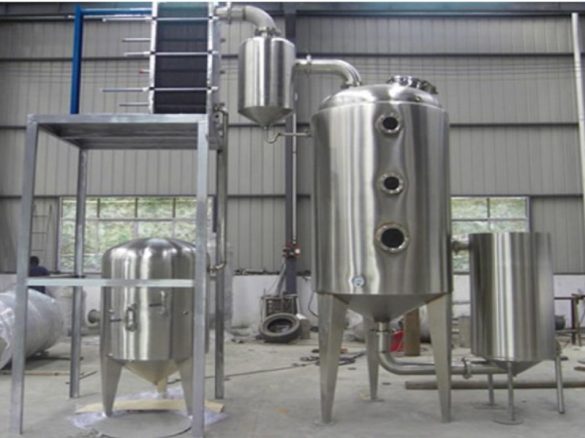
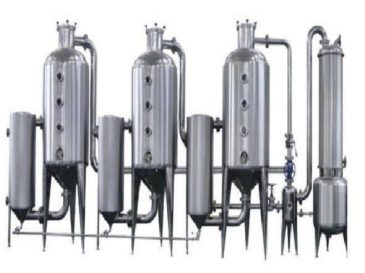
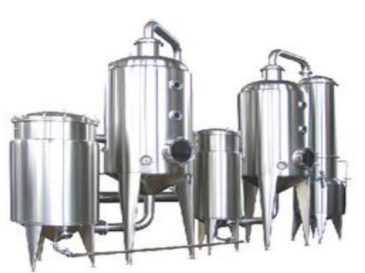
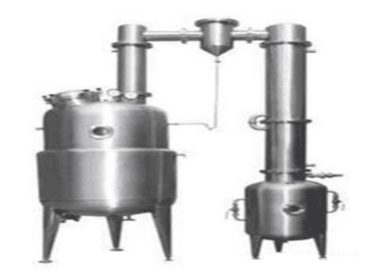
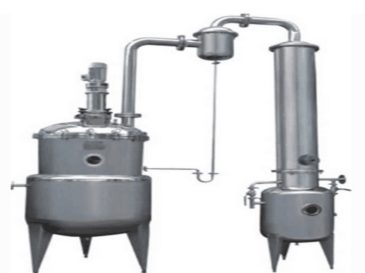
The rising membrane evaporator, also called an external circulation evaporator, uses heating tubes (heat exchange tubes), a separator, and a circulation pipe to create a closed-loop cycle.
Working Process:
Operators preheat the feed liquid to its boiling point or near it, then feed it into the bottom of the heating chamber. High-speed rising secondary steam drives the liquid upward along the heat exchange tube’s inner wall, where it evaporates. The liquid reaches the desired concentration at the top of the heating chamber, and the finished product discharges from the separation chamber’s bottom. The secondary steam rises to the upper separation plate group, which removes bubbles, water droplets, and impurities. This cleaned steam then acts as the heat source for the next effect.
Application Scope
This evaporator suits solutions with high evaporation volume, heat sensitivity, low viscosity, and a tendency to foam. It works best for single-pass operation, thanks to the material’s extremely short residence time, making it ideal for high-concentration evaporation. It is not suitable for highly viscous solutions or those that easily crystallize or form scale.
Advantages
- High Liquid Turbulence: The liquid must overcome gravity to rise, creating strong turbulence. This makes the unit suitable for high-viscosity products and materials that tend to form scale on heating surfaces.
- Stable and Efficient Operation: The system maintains stable product circulation across a wide range of operating conditions, ensuring consistent and efficient performance.