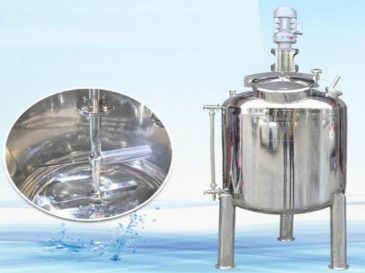
1. Overview and Material Requirements
We mainly make sanitary solution preparation tanks from high-quality SUS316L or SUS304 stainless steel. This material selection ensures the tanks meet strict sanitary requirements.
Specifically, these requirements include sterility, no contamination, easy cleaning and disinfection. Additionally, we design the internal surfaces of the equipment with smooth transitions to avoid dead corners.
2. Application Fields
Sanitary solution preparation tanks are widely used in multiple industries. These industries include dairy, food, beverage, pharmaceutical, and medical fields.
Among these, they are more widely applied in the pharmaceutical and food/dairy industries, where hygiene standards are the strictest.
3. System Configuration
3.1 Basic Configuration Components
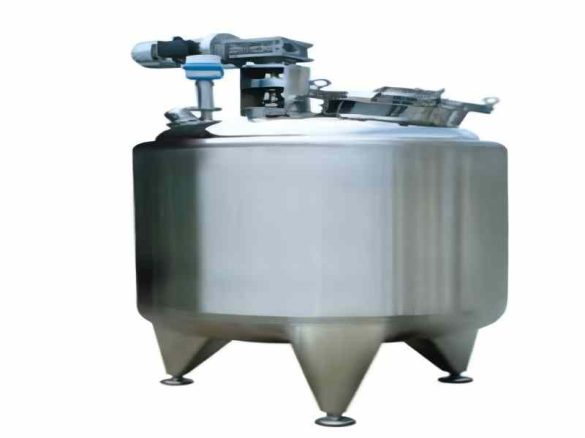
The system configuration of sanitary solution preparation tanks includes several core components. First, it includes a transmission device and a mechanical seal device for stable operation.
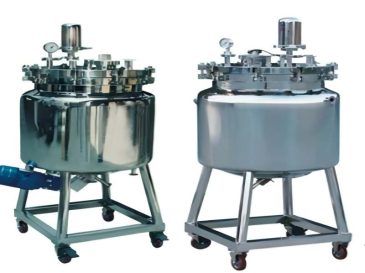
It also has a temperature control device, a spotlight, and a sight glass for real-time monitoring. Furthermore, it is equipped with a stirring device and a manhole feeding port for convenient operation.
Other basic components include a steam inlet, a condensate water outlet, a material outlet, a sewage outlet, and a sampling port. We also install a 360° universal cleaning ball for thorough cleaning.
3.2 Optional Configuration Components
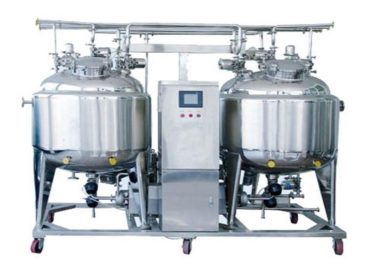
In addition to basic components, some tanks are also equipped with optional devices. These include an orifice plate filtration device, a weighing and metering device, and a liquid level metering device.
Moreover, some tanks can be equipped with a circulation device to enhance mixing uniformity and meet specific process needs.
4. Core Functions and Operational Process
4.1 Core Functional Features
Sanitary solution preparation tanks have four key functions. These functions are heating, cooling, heat preservation, and stirring, which cover the entire liquid preparation process.
We design the tank body with various process nozzles. These include a material inlet, a pure water port, a discharge port, and a sampling port to provide necessary conditions for the solution preparation process.
4.2 Post-Preparation Operations
After the solution preparation is completed, operators can turn on direct steam for sterilization and disinfection. This step ensures the solution meets hygiene standards.
Meanwhile, after the high-temperature solution preparation process is completed, if cooling is required, operators can cool the material first. They can then open the discharge valve to discharge the material.
In addition, we design pharmaceutical sanitary solution preparation tanks with a sterilization function as standard. This function further ensures compliance with pharmaceutical industry requirements.
5. Compliance Standards
Our sanitary solution preparation tanks comply with multiple national and international standards. First, they meet the Steel Pressure Vessels standard (GB150-2011).
They also comply with HG20584 (Technical Requirements for Manufacturing of Steel Chemical Vessels) and HG20583 (Structural Design Specifications for Steel Chemical Vessels).
Furthermore, they adhere to HG/T20569 (Mechanical Agitation Equipment) and the Current EU Good Manufacturing Practice (GMP) for Pharmaceuticals.
We also ensure compliance with Customer Requirement Specifications and SFDA Good Manufacturing Practice (GMP) for Pharmaceuticals (2010 Edition).
Additionally, the tanks meet ISO 14644 – 1, the Design Code for Clean Rooms in Pharmaceutical Industry (GB50457-2008), and GAMP (Good Automated Manufacturing Practice).