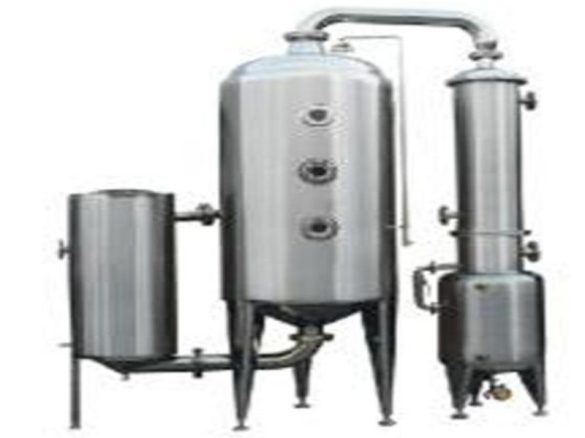
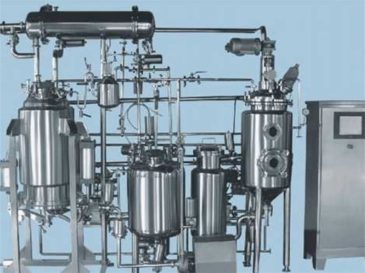
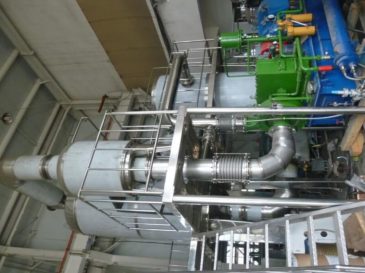
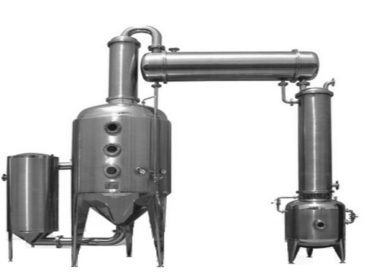
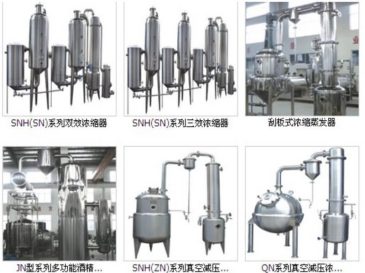
1. Overview and Application Scope
The TCM concentrator is suitable for various processes in industries such as traditional Chinese medicine, botanical extraction, biopharmaceuticals, food, and chemical engineering. Specifically, these processes include atmospheric pressure, slight pressure, water decoction, warm immersion, thermal reflux forced circulation, percolation, extraction and concentration of plant essential oils/aromatic oil components, as well as recovery and concentration of organic solvents. Moreover, it is ideally suited for R&D departments in universities, research institutes, and enterprise laboratories, as well as pilot production in small-to-medium pharmaceutical factories.
2. Basic Structure and Core Advantages
2.1 Material and Appearance
We construct the TCM concentrator from high-quality SUS304 stainless steel with mirror polishing, which ensures both aesthetic appeal and strong corrosion resistance, meeting the hygiene and durability requirements of related industries.
2.2 Structural and Operational Advantages
We design the equipment with high integration of components, which results in minimal floor space, simple operation, and high efficiency. Additionally, this equipment combines versatility with precision, enabling both laboratory-scale research and industrial-scale trial production while adhering to hygienic standards for pharmaceutical and food applications.
3. Key Performance Advantages
3.1 High Equipment Efficiency
The small-scale vacuum decompression thermal reflux dynamic extraction-concentration unit optimizes the structure based on original single-cone and inclined-cone models, and it integrates a small concentrator independently. This integration enables one-step completion of extraction, concentration, condensation, and filtration, which in turn saves raw materials and working time. Furthermore, its efficiency is 20%–35% higher than that of general multi-functional extraction equipment.
3.2 High Raw Material Conversion Rate
During extraction, hot solvents (either water or alcohol) continuously flow over raw medicinal materials, dissolving active components from top to bottom through the herb layer. This process increases the active ingredient content in the original liquid by over 100% compared to ordinary extraction. Additionally, the unit supports vacuum extraction to reduce the loss of heat-sensitive components. Besides, a frame-type agitator ensures large-volume herbs fully contact the solvent, which accelerates the release of active ingredients.
3.3 Enhanced Extraction-Concentration Efficiency
After one-time feeding, the original liquid circulates in a closed system, continuously extracting active components. This circulation saves over 30% of solvent compared to the same extraction volume. Moreover, the steam in the concentrator is reused, which reduces energy consumption by approximately 50%. Additionally, the evaporation chamber operates at low temperatures, which maximizes the retention of heat-sensitive components and ensures optimal concentration results.
3.4 Flexible Operation Mode
The extraction and concentration systems can operate either independently or in linkage. The extraction section features large-diameter manholes/handholes for easy residue removal, and the pipelines include filtration for secondary liquid purification, which prevents fine residues from entering the concentrator.
3.5 Superior Thermal Efficiency
The TCM concentrator is equipped with a small superheated water generator, which supplies high-temperature steam-water mixtures for all heating needs. This generator enables rapid heating and cooling with high thermal efficiency—its heating power is only about 50% of that of heat-conducting oil systems. Furthermore, the temperature control is sensitive (with ±1°C precision), responding quickly to operational commands and avoiding the slow natural cooling of heat-conducting oil systems.
4. Integrated Functional Design
The equipment comes with multiple integrated functions to enhance its practicality. First, it is equipped with an oil-water separator and a high-efficiency condenser for extracting plant essential oils (e.g., aromatic oils). Second, it features a digital temperature display, online monitoring, and illuminated sight glasses on the extraction and concentration tanks for easy process observation. Third, dedicated pipelines and valves between the extraction tank and vacuum concentrator enable continuous concentration without manual material transfer. Finally, the concentrator’s sampling valve allows for real-time concentration inspection, ensuring product quality.
5. Additional Advantages
5.1 Compact & Environmentally Friendly
The unit features a compact footprint and excellent environmental performance, with no pollution, odor, or steam leakage. Additionally, its fully enclosed design complies with GMP standards, making it suitable for pharmaceutical and food production.
5.2 Comprehensive Safety Features
The TCM concentrator is equipped with over-temperature alarms, minimum water level control, and steam pressure relief valves. All these features work together to ensure safe operation and prevent potential hazards.
6. Operational Process
6.1 Material Loading & Solvent Addition
First, operators feed medicinal herbs into the extraction tank and add 5–10 times the solvent (such as water, ethanol, methanol, acetone, etc., as per process requirements). This step lays the foundation for subsequent extraction.
6.2 Extraction Heating Phase
Next, operators activate the extraction tank’s heating system, bringing the extraction liquid to a boil. After 20–30 minutes, they use a suction filter tube to transfer 1/3 of the extraction liquid to the concentration tank, initiating the concentration process.
6.3 Concentration Operation
First, operators close the direct and jacket hot water systems of the extraction tank. Then, they activate the direct and heating systems of the concentration tank, maintaining the concentrate temperature at approximately 80°C and the vacuum degree at -0.05 to -0.09 MPa. During this process, the secondary steam generated during concentration is condensed by the condenser and cooler, returning to the extraction tank as fresh solvent. This fresh solvent flows downward through the herb layer to the bottom of the extraction tank, further dissolving soluble components from the herbs.
6.4 Circulative Extraction-Concentration Loop
The extraction liquid is suctioned into the concentration tank via the filter tube. Meanwhile, the secondary steam from concentration is reused as fresh solvent in the extraction tank, forming a closed-loop extraction system. This loop continues until the components are fully dissolved (when the extraction liquid turns colorless). After that, concentration continues until the medicinal paste reaches the required specific gravity, and the colorless liquid in the extraction tank can be reused for the next batch.
6.5 Organic Solvent Recovery (If Applicable)
For organic solvent extraction, operators first add an appropriate amount of water. Then, they activate the direct and jacket hot water systems to recover the solvent. Finally, they discharge the residue after solvent recovery is complete.
7. Technical Notes
First, the vacuum degree (-0.05 to -0.09 MPa) reduces boiling points, which helps preserve heat-sensitive components. Second, secondary steam recycling minimizes solvent consumption and energy use, improving cost-effectiveness. Third, the closed-loop design ensures continuous extraction efficiency while complying with GMP standards for hygiene and process control.