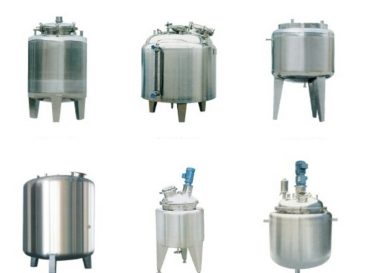
Overview of Stainless Steel Storage Tanks
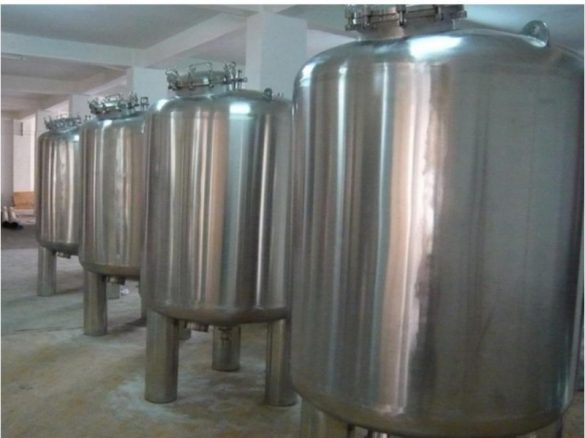
Stainless steel storage tanks are common storage equipment. Specifically, manufacturers make them from high-quality 304 or 316L stainless steel, while workers polish the inner and outer surfaces to be smooth with no dead corners. Additionally, they add manholes, material inlets/outlets, and level gauges as needed. These tanks often store materials requiring high hygiene and corrosion resistance, and stainless steel’s corrosion resistance, polishability, and sanitation make them popular. Furthermore, all stainless steel storage tanks are reliable and high-quality.
Classification of Stainless Steel Tanks
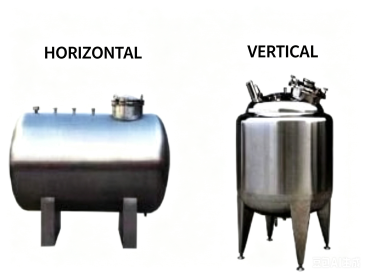
By form: Manufacturers divide them into vertical and horizontal stainless steel tanks. By use: Our categorization includes tanks for brewing, food, pharmaceuticals, dairy, chemicals, petroleum, building materials, electric power, and metallurgy. By sanitary standard: We distinguish between hygienic-grade and ordinary stainless steel tanks. By pressure requirement: Our classification covers stainless steel pressure vessels and non-pressure vessels.
Common Types of Stainless Steel Tanks
Common types include several varieties, such as storage tanks, pressure tanks, wine tanks, milk tanks, reaction tanks, vacuum tanks, and fermentation tanks.
Stainless Steel Tanks for Food & Pharmaceutical Industries
These include batching tanks, concentrated batching tanks, and dilute batching tanks. They also include extraction tanks, reaction tanks, and liquid storage tanks. In addition, other types are mixing tanks, seed tanks, sauce and vinegar tanks, and nitric acid tanks. Additionally, there are glacial acetic acid tanks and water tower tanks.
Stainless Steel Tanks for Brewing & Dairy Industries
They include wine tanks, Baijiu (Chinese liquor) tanks, and wine barrels. Meanwhile, dairy-related types are milk (dairy) tanks, beverage tanks, and milk tank trucks.
Stainless Steel Tanks for Chemical Industry
Chemical industry tanks include oil tanks, transportation tanks, and cooling tanks. They also include insulated storage tanks, heat-exchange storage tanks, and buffer tanks. Besides, other options are balance tanks, outdoor storage tanks, and all levels of pressure vessels.
Core Features of Stainless Steel Tanks
Stainless steel tanks have strong corrosion resistance; for instance, they resist corrosion from external air and residual chlorine in water. Moreover, workers conduct super-strong pressure testing on each spherical tank before delivery. Under normal pressure, their service life can exceed 100 years.
Airtightness & Water Quality Protection
Stainless steel tanks have excellent airtightness, and their sealed design blocks air dust and mosquitoes from entering. This ensures water quality stays unpolluted and prevents red worm breeding.
Scientific Water Flow Design
The scientific water flow design avoids stirring up bottom sediments and ensures natural stratification of domestic and fire-fighting water. As a result, domestic water turbidity from the tank is reduced by 48.5%, and at the same time, water pressure increases significantly. This improvement enhances the performance of domestic and fire-fighting water facilities.
Easy Maintenance & Low Cost
Stainless steel tanks do not need frequent cleaning; instead, workers can discharge water sediment by opening the bottom sewage valve regularly. They only need simple equipment to remove scale every 3 years, which reduces cleaning costs and avoids bacterial/virus pollution.
Light Weight & Aesthetic Advantages
Stainless steel tanks are light and have small wind loads. For example, a 10-cubic-meter stainless steel spherical tank weighs over 360 kilograms, which is only 1/38 the weight of a cement pool. They also have an attractive appearance and can be used with advertisements, making them excellent environmental protection products.
Water Conservation Benefits
Stainless steel tanks save large amounts of domestic water. For instance, Guangzhou has nearly 30,000 rooftop and underground water storage pools, and each 10-cubic-meter pool wastes over 1 million cubic meters of tap water yearly (cleaned 3-4 times). Real estate development is further expanding this waste, but new stainless steel spherical tanks can effectively eliminate it.
Mobile Storage Tanks
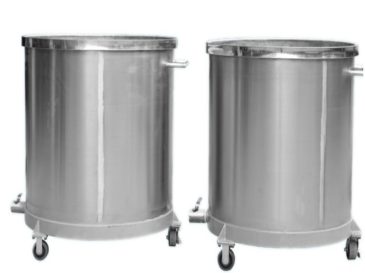
A mobile storage tank has mobile casters for easy pushing and is used for storage, buffering, and material feeding. It differs from fixed tanks by its mobility; due to this mobility, it is generally small (50L to 2000L), as larger sizes become inconvenient to move.
Mobile Storage Tank Specifications
Manufacturers can make it from carbon steel or stainless steel and can have a cover or be coverless as needed. Coverless mobile tanks are also called “la gang” (bucket-shaped) with casters, while covered ones can have detachable or integrated (welded head and cylinder) upper covers. Workers select the structure based on application and material characteristics.
Mobile Storage Tank Features
Mobile casters at the bottom enable easy movement, and it has a braking system for anytime parking. Additionally, workers can add stirring, metering, or delivery pump devices as needed, and we welcome customization of various mobile storage tanks.
Vertical Storage Tanks
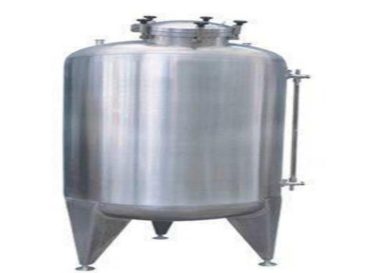
A vertical storage tank stands upright, supported by legs or a skirt. It can be stainless steel or carbon steel, selected by material characteristics, and mainly consists of a cylinder, upper/lower heads, legs, and level gauge. Other components include material inlets/outlets, a ladder, and a manhole.
Vertical Storage Tank Structure
Upper and lower heads have various forms, including upper flat/lower elliptical, upper/lower conical, and upper/lower elliptical heads. Head and cylinder connections can be flange, welded, flip-up, or half-flip-up, while level gauges can be glass tube, hydrostatic, or liquid level switch types.
Vertical Storage Tank Inquiry
Contact us for stainless steel, carbon steel, vertical, and horizontal storage tanks; we offer reasonable prices and guaranteed quality.
Horizontal Storage Tanks
A horizontal storage tank is structurally opposite to a vertical one; it uses saddle supports and has a low height, so it has no factory building height restrictions. Compared to vertical tanks, however, it occupies more floor space.
Horizontal Storage Tank Specifications
It can be carbon steel or stainless steel, selected as needed, and generally has left and right elliptical heads. A manhole is installed in the middle of the cylinder, and a level gauge on one head monitors liquid height. It uses two saddle supports (fixed or one fixed/one sliding).
Horizontal Storage Tank Customization
Our company designs and manufactures various horizontal storage tanks, and we welcome customization requests.