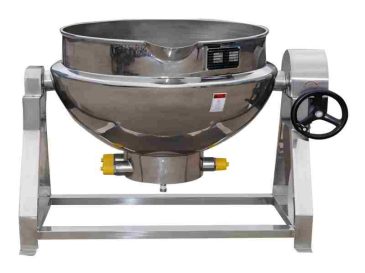
1. Product Overview and Core Functions
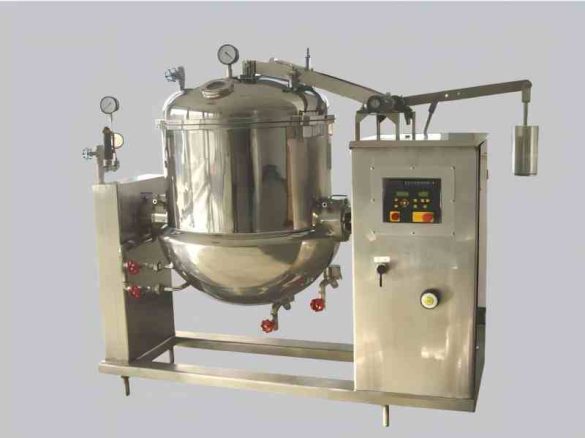
The multi-functional cooking tank has wide applicability in the design and production of food and pharmaceuticals. Specifically, it integrates multiple practical functions to meet diverse process needs, and it achieves this through a user-centric design.
For instance, engineers design it with functions such as high-temperature cooking, immersion boiling, and precise extraction. Additionally, it boasts other key functions to enhance operational efficiency, making it suitable for various production scenarios.
These functions include continuous temperature rise, constant-pressure cooking, cooling for liquid discharge, thorough slag removal, and easy cleaning. Moreover, the cooking tank can be customized for specific working conditions, so it can adapt to different production demands.
Engineers can design it to perform cooking and extraction at approximately 140°C under a pressure of 2-6 kg, thereby adapting to different production requirements and ensuring versatility.
2. Structural Design
The multi-functional cooking tank adopts a scientific vertical structure, and its detailed structural features are as follows. Each feature is designed to enhance stability and functionality.
① It adopts a vertical type with upper and lower elliptical heads, and manufacturers equip it with 4 lugs to ensure stable installation during operation.
② Manufacturers configure it with a standard jacket to support temperature control during the cooking process, which is crucial for consistent product quality.
③ Manufacturers equip it with insulation to reduce heat loss and maintain a stable working temperature, thus improving energy efficiency.
④ Engineers equip the interior of the equipment with a supporting grid plate and a detachable grate, which facilitates slag removal and cleaning after operation.
3. Pressure Parameters
The cooking tank strictly follows standardized pressure settings to ensure safe operation. Specifically, its pressure parameters are divided into operating pressure and design pressure, and both are set to meet safety standards.
4. Temperature Parameters
To match different cooking and extraction needs, engineers design the tank with reasonable temperature parameters, including operating temperature and design temperature. These parameters are tailored to various production scenarios.
5. Material Selection
The tank prioritizes material quality and safety, especially for parts in contact with materials. Manufacturers use S30408 stainless steel for all parts that come into contact with materials—including the jacket, lugs, and tower section flanges.
This material ensures corrosion resistance, hygiene, and durability, and it meets the strict requirements of food and pharmaceutical industries. As a result, the tank is safe for use in these sensitive sectors.
6. Plate Thickness and Cylinder Size Specifications
Engineers scientifically design the plate thickness of each part of the cooking tank to ensure structural stability and pressure resistance. The specific thickness specifications are as follows, and each specification is carefully calculated for optimal performance.
-
① Upper head: δ=12mm;
-
② Inner cylinder and lower head: δ=14mm;
-
③ Jacket and jacket head: 6mm;
-
④ Insulation cylinder body: δ=3mm;
-
⑤ Insulation head: δ=4mm;
-
⑥ Supporting ring plate and supporting plate: δ=12mm;
-
⑦ Rib plate: 80# δ=12mm.
In addition to plate thickness, the key size parameters of the cylinder are also standardized. Specifically, the inner cylinder is ¢170014, the jacket cylinder is ¢18006, and the insulation cylinder is ¢1900*3. These standardized sizes ensure consistency and compatibility.
7. Key Accessories Configuration
The cooking tank is equipped with a full set of high-quality accessories to ensure smooth operation and easy maintenance. The main accessories include the following, and each accessory plays a vital role in the tank’s operation.
Manhole: Manufacturers equip it with sanitary quick-opening manholes, including 2 fixed-type quick-opening manholes with DN550-0.4 specifications. Notably, the lower manhole is installed as close to the grate as possible to facilitate slag discharge, which saves time during cleaning.
Safety valve: Manufacturers equip it with one stainless steel safety valve with DN40-0.3 specifications, which ensures safe operation by releasing excess pressure and preventing potential hazards.
Cleaning ball: Manufacturers equip it with 1 fixed cleaning ball made of 304 stainless steel. It adopts a φ51/89 quick-opening detachable type and can rotate 360 degrees freely, which achieves thorough cleaning of the tank’s interior.
Dial thermometer: Manufacturers equip it with one dial thermometer with a threaded connection of M27*2 and a length of 150mm, which enables operators to monitor temperature in real time and adjust processes accordingly.
Pressure gauge: Manufacturers equip it with one pressure gauge with a range of -0.1~0.5Mpa and a threaded connection of M27*2, which facilitates operators to observe pressure accurately and ensure safe operation.
Explosion-proof lamp: Manufacturers equip it with one 36V, 20W explosion-proof lamp. The sight glass and lamp flange are DN100, and the lamp and mirror are detachable separately, which makes maintenance easier for operators.
8. Surface Treatment Requirements
The surface treatment of the cooking tank strictly follows hygiene and durability standards. First, workers perform mechanical polishing on the inner cavity of the cooking tank, ensuring a roughness of 0.45μm and no sand holes on the surface. This polishing process enhances hygiene and prevents material contamination.
Second, workers also perform mechanical polishing on the upper and lower heads of the tank’s outer surface, while they adopt a wiredrawn treatment for the outer straight cylinder with a roughness of 0.6~0.8μm. Additionally, the thickness of the thermal insulation aluminum silicate cotton shall not be less than 50mm, as this ensures effective heat preservation and reduces energy waste.
9. Nozzle Specifications
The tank is equipped with various nozzles to meet different operational needs, and their specifications are as follows. Each nozzle is designed for a specific function to ensure smooth production processes.
-
Cooling water inlet and outlet: DN50
-
Steam inlet and condensate outlet: DN50
-
Material inlet and outlet: DN50
-
Cleaning port: DN25
-
Pressure gauge port: DN25
-
Exhaust port: DN50
10. Pressure Vessel Certification and Compliance Standards
Engineers design the multi-functional cooking tank according to Class I pressure vessel standards. We provide pressure vessel certification and hydrostatic test documents to ensure compliance with safety regulations, giving customers peace of mind.
Furthermore, the product complies with multiple national and industrial standards, including the following. These standards ensure the tank’s quality, safety, and compatibility with industry requirements.
-
GB150-2011 Steel Pressure Vessels;
-
TSG R0004-2012 Safety Technical Supervision Regulations for Stationary Pressure Vessels;
-
HG/T 20569-1994 and HG 20584-2011 Technical Requirements for Manufacturing of Steel Chemical Vessels;
-
Good Manufacturing Practice for Drugs (GMP).