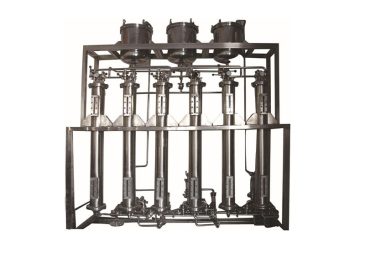
1. Overview
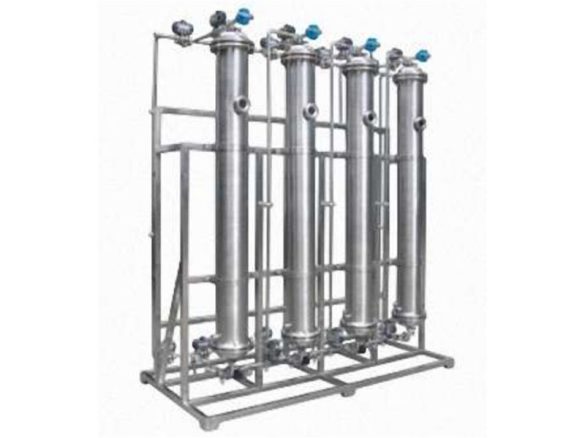
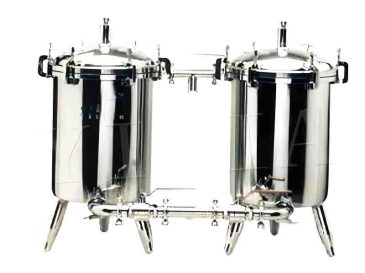
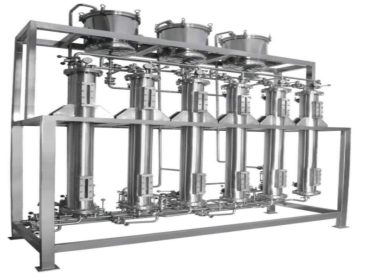
Stainless steel resin columns are commonly used equipment.
They serve both laboratory and industrial purposes.
We mainly use them for substance separation.
Additionally, they assist in purification and preparation processes.
2. Main Components
2.1 Column
We usually make the column from stainless steel.
It is strong, durable and pressure-resistant.
Moreover, it can withstand certain pressure changes.
It also tolerates specific temperature changes.
For this reason, it suits various industrial environments.
Stainless steel meets GMP requirements.
This ensures equipment hygiene and safety.
2.2 Resin Bed
The resin bed is the core of the adsorption column.
We fill it with macroporous or other resins.
The resin has good adsorption properties.
Specifically, it selectively adsorbs specific mixture components.
This achieves substance separation and purification.
2.3 Inlet and Outlet
The inlet and outlet are at the column’s two ends.
The inlet is at the upper end for feeding.
Meanwhile, the outlet is at the lower end for discharging.
The inlet introduces the solution to be treated.
It ensures full contact with the resin bed.
Subsequently, the outlet discharges the adsorbed solution.
2.4 Filter Device
The column has an internal filter device.
Examples include stainless steel filter screens.
Besides, stainless steel water caps are also common.
It prevents resin particles from entering the solution.
This ensures the discharged liquid’s purity.
3. Working Process
3.1 Adsorption
The solution enters the resin column via the feed port.
It fully contacts the resin bed layer.
Then, the resin adsorbs specific components in the solution.
This realizes substance separation.
3.2 Elution
After adsorption, we elute the resin column.
We use eluent for the elution process.
It replaces target substances on the resin surface.
As a result, this forms high-concentration target eluent.
3.3 Regeneration
Resin adsorption performance may decrease over cycles.
These cycles include adsorption and elution.
We need to regenerate the resin at this time.
Ultimately, regeneration restores its adsorption activity.
4. Application Fields
4.1 Pharmaceutical Industry
We use it to extract Chinese medicine active ingredients.
Examples include ginsenosides and flavonoids.
It also purifies western medicine intermediates.
Furthermore, it removes impurities and isomers.
This improves drug quality and efficacy.
4.2 Food Industry
It aids in food additive production.
We use it to extract sweeteners and pigments.
It also removes harmful food substances.
These include pesticide residues and heavy metals.
Thus, it ensures food safety effectively.
4.3 Environmental Protection
It is widely used in wastewater treatment.
It adsorbs organic matter in wastewater.
Additionally, it removes heavy metals and dyes.
It reduces wastewater COD and BOD.
It lowers wastewater color as well.
This meets discharge or reuse standards.
4.4 Chemical Industry
It separates and purifies organic synthesis products.
Examples include catalyst recovery.
It refines organic intermediates too.
Moreover, it pretreats chemical raw materials.
It removes impurities and harmful substances.
This improves raw material quality.
It also enhances reaction activity.
5. Core Advantages
1. High efficiency: It has strong adsorption capacity.
It also boasts high separation efficiency.
Furthermore, it quickly extracts desired substances.
2. High selectivity: Resin adsorbs selectively.
It depends on molecular size and polarity.
In addition, it has high affinity for specific substances.
3. Good stability: It has strong mechanical strength.
It also has good chemical stability.
Notably, it operates stably in wide conditions.
These include temperature, pressure and pH.
4. Simple operation: The process is easy to master.
We adjust inlet and outlet parameters.
This realizes adsorption and elution.
It also enables regeneration easily.
5. Reusable: Resin can be reused after regeneration.
This reduces production costs.
It also decreases resource waste.