1. Overview
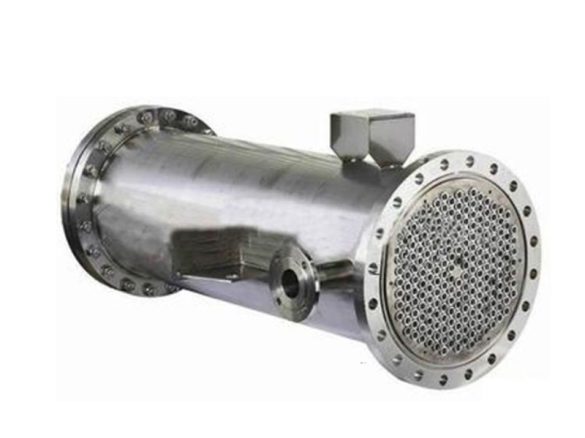
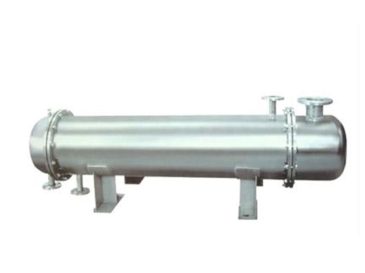
Shell and tube heat exchangers are common heat exchange equipment.
We use them widely in many industries.
These industries include food, chemical, pharmaceutical, and petroleum.
They are a general type of industrial equipment.
2. Composition and Material Selection
Shell and tube heat exchangers have main components.
These include shell, tube plate, heat exchange tube, head, and baffle.
We can make them from various materials.
Common materials are ordinary carbon steel, red copper, or stainless steel.
We use stainless steel for most shell and tube heat exchangers.
Examples include stainless steel heat exchangers and condensers.
Stainless steel coolers also belong to this category.
3. Common Type: Fixed Tube Plate Shell and Tube Heat Exchanger
Fixed tube plate shell and tube heat exchangers are widely used.
They have a simple and compact structure.
They are also inexpensive compared to other types.
However, we cannot mechanically clean the outside of the tubes.
4. Tube Pass and Shell Pass
The two media in the exchanger pass through different spaces.
We call the space inside the tube the tube pass.
The space outside the tube (inside the shell) is the shell pass.
The media in the shell pass and tube pass are different.
5. Selection Principles for Cold and Hot Fluid Channels
We follow specific principles to select fluid channels.
1. Unclean, scale-prone liquids go through the tube pass.
This makes cleaning the tube interior convenient.
2. Corrosive fluids should go through the tube pass.
This avoids corroding both tube bundle and shell.
3. High-pressure fluids go through the tube pass.
This prevents putting pressure on the shell.
4. Saturated steam goes through the shell pass.
It is clean and has a stable heat transfer coefficient.
Its condensate also drains easily.
5. Fluids to be cooled go through the shell pass.
This facilitates heat dissipation effectively.
6. For large temperature differences and rigid structures.
Let fluids with high heat transfer coefficients go through the shell pass.
This reduces thermal stress significantly.
7. Fluids with small flow and high viscosity go through the shell pass.
8. Structure Details of Fixed Tube Plate Type
The tube bundle connects to the tube plate.
We weld the tube plate at both ends of the shell.
A top cover connects to the tube plate.
The top cover and shell have fluid inlet and outlet pipes.
9. Baffles: Function and Types
We arrange a series of baffles outside the tubes.
They are perpendicular to the tube bundle.
Baffles increase the shell fluid’s flow rate.
They prevent fluid short circuits effectively.
They force fluid to pass through the tube bundle.
Fluid flows in counterflow multiple times as required.
This greatly increases the degree of turbulence.
Common baffles are semicircular and disk-shaped.
Semicircular baffles are more commonly used.
10. Heat Exchange Tube Specifications
Shell and tube heat exchangers use common tube sizes.
These sizes are 19, 25, and 32 (unit: mm).
We determine the specific size based on heat exchange area.
We also consider material characteristics and temperature pressure.
Common heat exchange tube lengths vary.
They are 1m, 1.5m, 2m, 2.5m, 3m, 4.5m, and 6m.