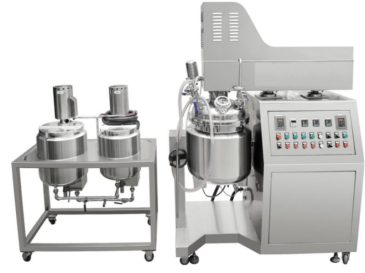
1. Overview and Application Scope
In a broad sense, we also call the phenolic resin reactor a resin reactor.
It applies to the entire resin production range.
This range includes various saturated and unsaturated resins, polyester resins, and phenolic resins.
It also covers epoxy resins, ABS resins, and other similar products.
We heat the materials inside the reactor to promote mutual reactions between them.
According to different process requirements, we design different container structures and configure parameters.
This design achieves process-required functions such as heating, cooling, and evaporation.
It boasts rapid heating, high temperature resistance, corrosion resistance, and low environmental pollution.
Moreover, it is one of the most commonly used reaction equipments in food, biopharmaceuticals, and fine chemicals.
We use it to complete process reactions like sulfuration, alkylation, hydrogenation, condensation, and polymerization.
2. Complete Equipment Composition
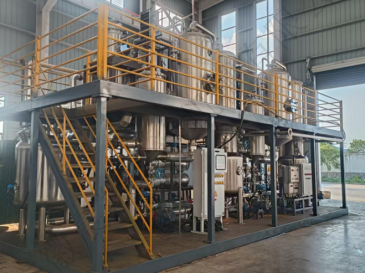
The complete set of equipment includes multiple components.
These components are a phenolic resin reactor, vertical fractionating column, and horizontal (or vertical) condenser.
It also includes a water storage device, head tank, dilution tank, and pipelines.
We make all parts of the complete equipment that contact materials from stainless steel.
3. Main Structure of Phenolic Resin Reactor
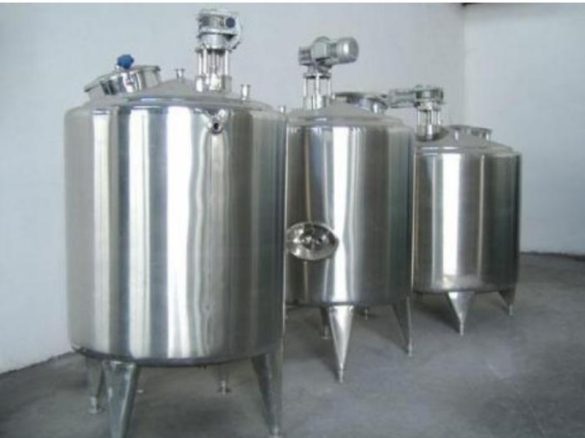
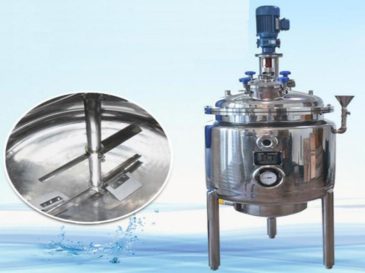
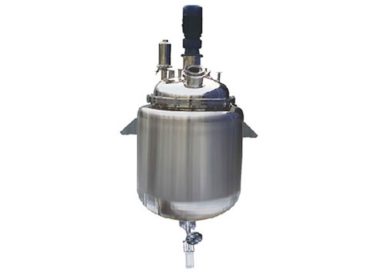
The phenolic resin reactor mainly consists of several key parts.
These parts include the reactor body (cylinder), reactor cover (head), and jacket or coil.
It also has a stirring device (stirrer), transmission device (motor reducer), and shaft sealing device.
Additionally, it includes supports (platforms, legs) and thermal insulation media.
Besides these main parts, we equip it with multiple auxiliary devices.
These devices include a temperature monitoring device, temperature measuring holes, and a CIP automatic rotating spray ball.
It also has quick-opening material inlets and outlets, a temperature sensor, and a sight glass spotlight.
Furthermore, it is equipped with a liquid level gauge and heating/cooling medium outlets.
These auxiliary devices facilitate manual operation and help the solvent distribute evenly.
4. Material and Surface Treatment
Most phenolic resin reactors use stainless steel and other composite materials.
We mostly use imported SUS304/316L high-grade stainless steel for cylinder parts that contact materials.
We mechanically polish or electrolytically mirror-polish the inner cylinder wall.
The outer cylinder wall adopts a 304 fully welded structure.
We finish the outer surface with a mirror or matte finish.
For the cylinder’s external connections, we use sanitary quick-connect joints.