First, people widely use stainless steel seed tanks as reaction equipment for microbial growth. In the seed tank, various microorganisms grow and metabolize in a suitable environment, and they also form fermentation products during this process.
Generally speaking, seed cans are containers for storing or producing seeds. Besides, they serve as important fermentation equipment, and people have widely applied them in pharmaceutical, monosodium glutamate, enzyme preparations, food and other industries.
Seed cans have a wide range of applications. Specifically, they are suitable for the fermentation and brewing of yogurt and lactic acid bacteria beverage mother liquor. Additionally, they are also applicable to condiment production, pharmaceutical, chemical and fungal cultivation fields.
In addition, people can also understand seed cans as culture tanks or fermentation tanks. They have heating, heat preservation and cooling functions, and moreover, they are fully enclosed and hygienic special fermentation equipment.
Manufacturers make seed cans from imported 304 and 1Cr18Ni9Ti materials. This equipment has many advantages: it saves energy, reduces noise, resists corrosion, and has strong productivity. Besides, operators can easily clean and operate it.
There are two main types of seed cans. Specifically, they are carbon steel seed cans and stainless steel seed cans.
The fixed seed can mainly consists of the tank body and feet. Workers make the tank liner and head from high-quality stainless steel and polish them carefully.
Workers make the jacket and reinforcing bars from A3 plates, and they compose the insulation layer of glass asbestos. They also polish the outer skin into a fish scale pattern.
It adopts high-quality 304 and 1Cr18Ni9Ti materials, and workers use a mechanical seal for the connection between the agitator and the lid.
Workers use stainless steel studs for the connection under the tank lid, and they adopt XB250 non-toxic rubber for the sealing gasket.
A. Due to long-distance transportation, you should first check each connecting thread carefully.
B. You need to conduct an empty vehicle trial operation for the agitator; only after the transmission components run normally can you put them into formal operation.
C. After connection, you should check all joints. If leakage occurs, tighten the pipe joints and studs; you can put it into normal operation only when there is no leakage.
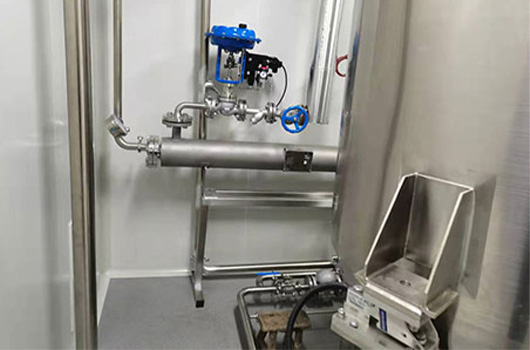
ThFirst, the stainless steel mixing tank mainly consists of three parts. These parts are the tank body, jacket, and mixing…
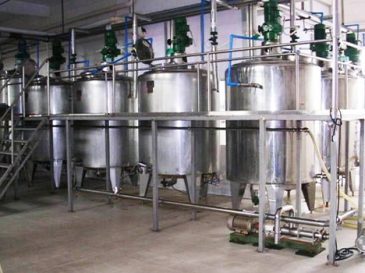
People also call some dispensing tanks preparation tanks. As the name suggests, these tanks prepare liquid preparations or liquid medicines.…
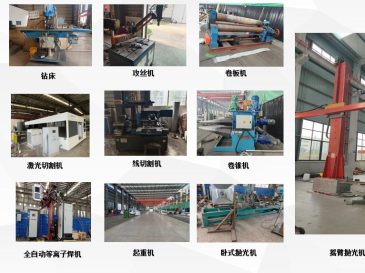
Recently, our company has upgraded its stainless steel tank production workshop technology, following the industry’s intelligent development trend. We introduced…